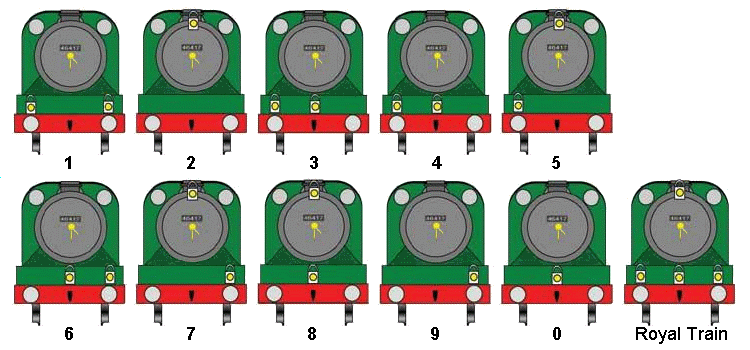
The “full house” headcode for the Royal Train was always outside the standard classification.
Since the railways in Great Britain have always been fenced, there has never been a requirement for headlights to warn of their approach. However, the signalman needed to be sure of the identity of the trains under his control to assist in routing and regulating the train correctly. The headcode indicated the class of train and helped the signalman regulate (prioritise) trains, especially when services were disrupted. Headcodes started appearing around 1850 and the Railway Clearing House (RCH) standardised a set of headcodes ‘A’ to ‘K’. The Southern Railway and the Great Western Railway used additional headcodes to indicate routing.
The standard was changed around the time of The Grouping in 1923 but was still lettered ‘A’ to ‘K’. This stood the test of time until 1960 when British Railways changed the classifications to a numeric system and introduced the four character headcodes. There was a final change after 1968 when steam was withdrawn and unfitted wagons were becoming rarer.
This is the headcode classification as used from 1961 to 1968, the era I’m modelling:
| |
| 1. | Express passenger train, newspaper train, breakdown train or snowplough going to clear the line, light engine going to assist a disabled train, or officer’s special not requiring to stop in section. |
| 2. | Ordinary passenger train, mixed train, breakdown train not going to clear the line, branch passenger train (where authorised by the Regional Operating Officer). |
| 3. | Parcels, fish, fruit, meat, milk, horsebox, cattle, pigeon, or perishables train composed entirely of vehicles conforming to coaching stock requirements, or empty coaching stock train not authorised to carry headcode for Class 1. |
| 4. | Express freight train brake piped throughout and with the automatic brake operative on not less than 90% of the vehicles. Maximum speed 55mph. Same headcode as group 3, but difference apparent on 4-character headcodes. |
| 5. | Express freight train partly fitted with the automatic brake operative on not less than 50% of the vehicles. Maximum speed 50mph. |
| 6. | Express freight train partly fitted with the automatic brake operative on not less than 20% of the vehicles. Maximum speed 45mph. |
| 7. | Express freight, livestock, perishables, or ballast train not fitted with the automatic brake. Maximum speed 40mph. |
| 8. | Through freight, livestock, perishables, or ballast train not fitted with the automatic brake. Maximum speed 35mph. |
| 9. | Freight, mineral or ballast stopping at intermediate stations, freight, ballast, or officer’s special train requiring to stop in section, branch freight train (where authorised by the Regional Operating Officer). |
| 0. | Light engine or engines coupled together, or engine with not more than two brake vans. |
The “full house” headcode for the Royal Train was always outside the standard classification. |
It seems odd nowadays to think of a train being classified as “express” when it was limited to 40mph!
The lamps were placed on the appropriate lamp irons and were not necessarily lit during daylight hours, they were required to be lit during the hours of darkness or during fog or falling snow. Early diesel engines used the same system, having split disks that could be hinged open to show a white disk, or closed to show body colour and therefore be hidden. They had an electric lamp built into the bodywork in the lower half of each disk for use at night-time.
Shunting engines also had to carry lamps. In the old British Railways Rule Book, Rule 123 stated:
| “Engines employed exclusively in shunting at stations and yards must, after sunset or during fog or falling snow, carry one red and one white light, both at the front and rear, one over each buffer.” |
Where the engine was shunting adjacent to a running line, the white light was placed nearer to the running line and the red light on the far side, to avoid possible confusion with fixed signals. In a black-and-white photograph, this would be indistinguishable from the Class 1 Express Passenger train headcode.
In the new Modular Rule Book, a similar rule can be found in paragraph 4.4 of Module TW1: Preparation and movement of trains, General.
There is a very good website here that has more information on headcodes and how they changed.