KSJ 190
Tim writes:
Firstly – I have my Father to thank for giving me ‘the bug’ – having had his ’63 rag-top since 1971, and the 412s described in these pages. Growing up around the air-cooled burble was bound to have an effect, so when, in 1997, I was approaching my seventeenth birthday, I wanted nothing else!
I decided that I would like to restore a Beetle, so I could find out more about how they work, and to ensure I ended up with one in the style and specification I really wanted. We looked at the shows for a suitable restoration project, but eventually found this ’62 in the back of a magazine. The owners were half way through the restoration when they were offered an immaculate ’60 for an attractive price. They abandoned the ’62 project and sold it to pay for the ’60 – well, wouldn’t you?
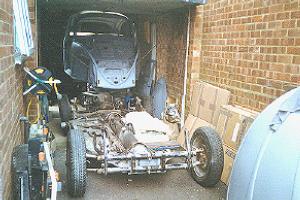 One of the first things we did was lift the body-shell from the floor-pan. Due to our lack of space, the body was hung from the garage roof, and the chassis rolled out from underneath when we worked on the car. The advert had said the body was 90% complete, but of course, it was much worse than this, and it took us a nine months to sort out the rust. Eventually, however, the original shade of Gulf Blue was laid on and we began the refit, which took another eight months. Due to a small budget, many used parts were purchased – I considered this to be better than using cheap reproduction parts. We were told the engine had recently been built, so we fitted the ancillaries we had collected and ran it as it was. When we drained the oil, we found fragments of a piston, but assumed they were left over from previous damage.
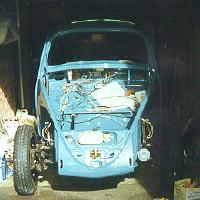 All the work on the car (except the re-spray) was done by my father and myself in his single garage and driveway, and she passed the MoT test on the 22nd June 1999. (It was actually the second time that day, as we had originally forgotten the split pins through the track-rod-end castle-nuts.) I made it down to Somerset and back a couple of days later, and to BVF at Malvern the following weekend, with no problems. Everything went fine until November 1999, when the engine expired, and to keep the car on the road, we installed a replacement engine. We suspected a con-rod was the problem, and sure enough when I rebuilt the old (not original) engine over Easter 2000, a piston and barrel were cracked, a con-rod was twisted and the cam follower had destroyed its guide. Needless to say, the case was a write off. So much for the engine having been rebuilt . . .
Unfortunately, in Autumn 2000, I started studying at Oxford Brookes University and had to leave the car at home in the garage while I was away during term time. Looking on the bright side, however, this meant that I could realistically limit my mileage to 5000 per year – earning a much-needed discount on my insurance. This year, I have taken the car with me to Oxford, so I can enjoy driving it much more often.
The registration number on the car is actually her third. The original was 712 MRL, but someone (a certain M. R. Lister) bought the car and then quickly sold it on, having kept the number for himself. The number AHJ 373A was given and these plates (in white and yellow reflective – Yuk!) were attached when I got the car. However, I didn’t like the “1963” registration, so applied to the DVLA for a historic plate. I was issued with KSJ 190, after being told that the original was still in use. The car’s chassis number is 4 053 576, and the date of manufacture was the 17th August 1961, which makes it a ’62 model. She was heading for Great Britain the next day, and was first registered on the 24th October. My certificate from the Wolfsburg Museum tells me that options 348 and 079 were chosen, but don’t know what these codes refer to. The original engine number was 5 995 326.
I have added a few extras to the car – a home-made parcel shelf and gear knob, fire extinguisher, front spotlight, rear fog and reversing lights, mud-flaps and a Bosch Blue Coil.
I hope to find a sturdy tow bar soon – my Dad’s has saved his ’63 on more than one occasion (once when another Beetle ran into the back of him and was nearly written off).
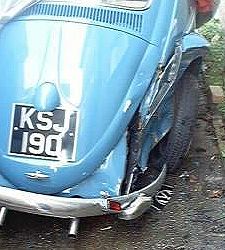
That last comment was unfortunate. Tim’s car was heavily modified by someone one evening in Oxford. It took a full seven weeks to complete the negotiations with the insurance companies but everything was eventually agreed and the car taken in for repair. Tim was hoping it would be back within a month but the work dragged on waiting for parts, then they couldn’t match the paint, and he finally collected the car after 15 weeks! No wonder all our premuims are so high – it’s to cover their inefficiencies!
| The car behind was a Toyota and it didn’t want to stop! But it didn’t drive away afterwards! |
 |
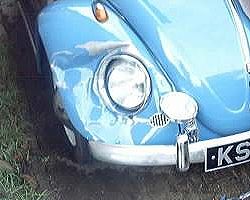 |
The car in front was a Mercedes and it hardly had a scratch! |
Happier times . . .
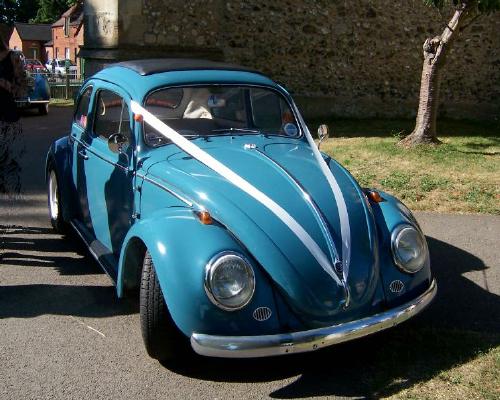
The car served duty for my daughter’s wedding in July 2006. Here it is, basking in the sunshine after the service.